

Related News
















by, Alex Harding, CFA
Senior Vice President, Ferguson Wellman Capital Management
Two milestones in the bond market framed late August, and neither were especially welcome. The yield on the 30-year Treasury pushed up against 5.3%, its highest level in nearly two decades. Then, the Treasury department reported that total public debt out standing had crossed $40 trillion for the first time. The measure economists watch, debt held by the public, sits closer to $32 trillion — roughly 100% of GDP, a share not seen since World War II. The roughly $8 trillion gap between the two figures is money the government owes itself, largely bonds held inside trust funds such as Social Security. The $32 trillion held by the public must find a buyer and determines interest rates. The juxtaposition of these two headlines at the same time were difficult to ignore and underscore an unsustainable long-term fiscal trajectory. The government owes more than ever and it is happening at a time when investors are demanding more to finance that debt. U.S. Treasury Secretary Scott Bessent then gave a surprise announcement that caught bond investors off guard.
On August 19, Bessent announced the Treasury would at least double its liquidity support buy back operations in the 10-to-30-year portion of the curve, lifting the maximum from $2 billion per operation to at least $4 billion. The Treasury is buying back older, less actively traded long-dated bonds, and funding those purchases with new short-term bonds. It is not retiring debt but rather reshaping it, pulling 10-to-30-year Treasury bonds out of private hands and handing back Treasury bills instead. This caught bond shorts off guard and delivered an immediate rally, but the operation was small relative to the market and the effect had largely faded within a day.
Signal Over Substance
We view this operation as a signal from the administration rather than a durable change in how many long-term bonds investors must absorb. Consider the scale: an incremental $14 billion of purchases over two months is small in comparison to more than $32 trillion of publicly held debt. The enlarged pace would represent roughly 2.4% of outstanding debt in those maturities. The Federal Reserve can create money to buy bonds; the Treasury cannot. Every dollar of long-term bonds it repurchases must be financed by issuing a dollar of short-term bills. Most importantly, the operation does not directly address the underlying drivers of higher rates (deficits near 6% of GDP, a fiscal 2026 shortfall now tracking above $2 trillion and a private sector competing for the same pool of capital). A day later, the 10-year interest rate had drifted back toward 4.7%, roughly where it had been.
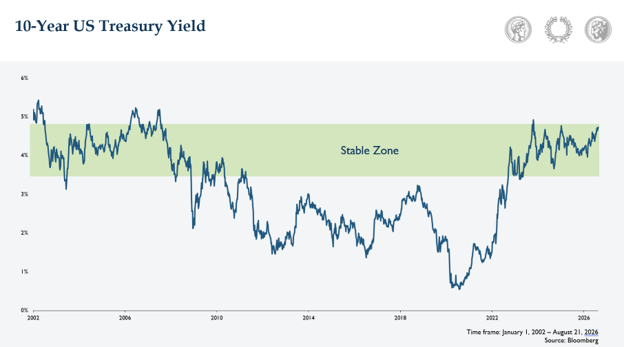
Several factors are causing demand for greater compensation for long-dated U.S. debt:
- The AI buildout has unleashed a wave of corporate borrowing
- Long-end yields are rising across developed markets globally
- Oil prices and the inflation path remain in flux, and fiscal sustainability remains a concern
- New Fed Chair Kevin Warsh has suggested he would prefer the market determine the long end, offering little forward guidance on monetary policy, establishing a stance that, we believe, sits awkwardly beside a Treasury secretary actively leaning on it.
Watching the Stable Zone
None of this suggests that a debt crisis is around the corner. The U.S. borrows in its own currency. Treasuries remain the world’s preferred safe asset and buyers keep showing up. The nearer-term cost is more subtle. We generally view 3.5% to 4.75% as a “stable zone” for the 10-year U.S. Treasury — the range in which markets appear to be balancing growth, inflation and fiscal risks. As of September 10, we are sitting above that stable zone range. History suggests stocks tend to face headwinds when yields push meaningfully above the upper edge, as safer bonds begin competing more directly for investor dollars. It’s a line we will be watching closely in the weeks and months ahead.
